
The Complete Guide to Building a Pool House in Summit, NJ
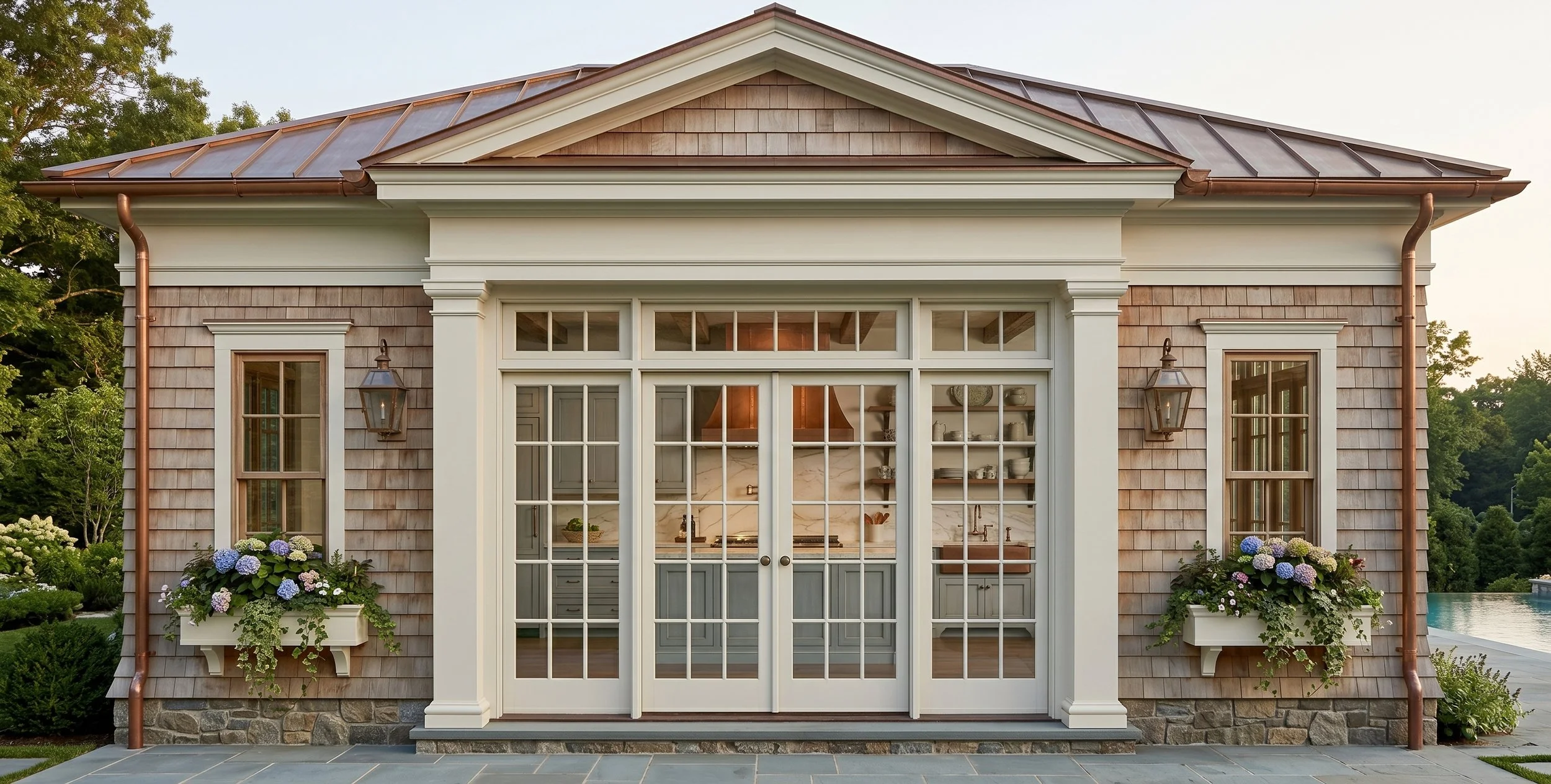
An rendering of a 24ft x 24ft pool house we designed in Summit which is currently under construction.
Introduction: Why a Pool House?
A pool house is one of the most enjoyable investments a Summit homeowner can make. It extends the functional season of your backyard, creates a true destination for entertaining, and adds a layer of convenience — dry towels, cold drinks, a place to change — that transforms a swimming pool from an amenity into a lifestyle. Done well, a pool house also meaningfully enhances a property's value and curb appeal.
At John James Architecture LLC, we have guided Summit families through every stage of this process, from the first conversation with the zoning officer to the day the doors open for a summer party. This guide consolidates everything we know, rooted in Summit's actual zoning code, so you can approach the project with confidence.
What Is a Pool House — and What Can It Contain?
A pool house is a freestanding structure on your property designed to support the use of your pool. In Summit, New Jersey, the zoning code classifies it as an accessory structure — a building or use that is secondary and subordinate to the principal residence on the lot. This classification, found in § 35-9.8 of the Summit Land Use Ordinance ("Accessory structures and uses"), is the legal foundation that shapes everything about what you can and cannot build.
What a Pool House Can Contain
Within its allowed square footage, a pool house can be a surprisingly complete and comfortable space. Common program elements include:
• A full bathroom — shower, toilet, and vanity — so guests never need to track wet feet through the main house.
• A kitchenette or wet bar, or even a full outdoor-style kitchen with refrigerator, ice maker, dishwasher, and prep counter.
• A laundry room or laundry closet, convenient for pool towels and outdoor cushion covers.
• A lounge or sitting area, which can double as a covered outdoor room when fitted with folding glass walls.
• Mechanical and storage space — many pool houses include a basement that houses pool equipment, seasonal storage, or a small wine cellar.
What a Pool House Cannot Be: No Dwelling Units
The one firm legal limit is this: a pool house cannot function as a dwelling unit. Section § 35-9.8(B)(1) of the Summit zoning code states plainly:
“No accessory building shall be used as a dwelling unit or for the conduct of a home occupation.”
A dwelling unit, as the term is used in Summit’s ordinance, is a room or connected suite of rooms providing complete, independent living facilities for one or more people — including provisions for sleeping, eating, cooking, and sanitation. In other words, it is a space someone could genuinely live in independently.
Practically speaking, this creates an important design constraint: a pool house can include a kitchen and a bathroom, but adding a dedicated bedroom alongside those two features pushes the structure into dwelling-unit territory. A space that has sleeping accommodations, cooking facilities, and a bathroom begins to look like an accessory dwelling unit, which is not a permitted use for an accessory structure in Summit’s residential zones. If you want a lounging daybed or a pull-out sofa, that’s a design conversation worth having with your architect, but a distinct bedroom door with closet will raise flags. We navigate this line carefully on behalf of our clients to maximize livability without crossing into non-compliance.
Summit Zoning Rules for Pool Houses: The Numbers That Matter
Summit’s rules for accessory structures are specific and worth understanding in detail. All of the following rules come from § 35-9.8 of the zoning ordinance.
Maximum Size: 576 Square Feet, No Dimension Longer Than 24 Feet
Section § 35-9.8(B)(2) sets the limit:
“In residential zones, no accessory building or structure shall have a floor or ground area in excess of 576 square feet, nor shall any dimension be longer than 24 feet.”
That is 24 feet by 24 feet — the same footprint as a two-car garage. It is a genuinely usable size, but it is not large. Every square foot counts, and program planning is critical. You are not working with the same scale efficiencies as the main house, so we spend significant time on layout to ensure the space feels generous rather than cramped.
Note that the 576-square-foot limit applies to the above-grade footprint. A basement, if included, can add meaningful additional square footage below grade for storage, mechanical equipment, or other uses (more on basements below).
Maximum Height: 15 Feet As-of-Right, Up to 18 Feet with City Approval
Section § 35-9.8(B)(3) addresses height:
“Except as specifically permitted elsewhere in this chapter, no accessory building or structure shall exceed 15 feet in height. Detached garages and pool houses for single- and two-family homes may exceed the maximum fifteen-foot height requirement only when it is determined that such an increase in height is required to match the roof pitch of the principal building for purposes of design continuity, and where the required setbacks of the accessory structure conform to the requirements of this chapter. In no case shall garage or pool house height exceed 18 feet.”
The 15-foot height limit is what the code allows as-of-right. To reach up to 18 feet, the increased height must be necessary to match the roof pitch of the main house — it is a design-continuity provision, not a blanket allowance — and it is subject to the City’s review and approval.
The Eave Wall Limit: 10 Feet
The same section includes a critical detail that directly shapes your interior design options:
“The two lowest exterior walls of any accessory building or structure shall not exceed a vertical dimension of 10 feet.”
This means the exterior side walls, from the ground to where the roof begins (the eave), can be no taller than 10 feet. The total building height — up to 15 or 18 feet — is then accounted for by the roof structure above that 10-foot eave.
This wall-height constraint has a direct consequence for interior space: there is not enough room between the 10-foot eave and the maximum overall height to fit a true second story or a functional sleeping loft. A loft would need a floor-to-ceiling height of at least 7 to 8 feet, which is simply not available within the envelope the code creates. Design strategies that work well within this constraint include vaulted ceilings (which use the full height of the roof for dramatic interior volume) and dormers (which create pockets of natural light and local height within the roofline).
The Basement Option
The zoning code does not prohibit basements in accessory structures. A pool house basement is a popular choice among Summit homeowners because it effectively expands the functional square footage without counting against the 576-square-foot above-grade limit. Basements in pool houses are commonly used for pool mechanical equipment (heaters, pumps, filters), seasonal storage, wine storage, and even small home theater or game room spaces. If you are investing in a pool house, seriously consider whether a basement makes sense — the incremental cost is real but the added utility is substantial.
What Does a Pool House Cost in Summit, NJ?
In Summit, clients should expect to budget in the range of $400,000 to $800,000 for a pool house, with the wide range reflecting meaningful differences in basement inclusion, finishes, fixtures, program complexity, and site conditions.
That range surprises many homeowners at first. The key to understanding it is recognizing that a pool house carries almost all of the same infrastructure costs as a primary home — foundation, framing, roofing, electrical service, plumbing rough-in, HVAC, insulation, and exterior finishes — just without the benefit of scale. When you build a 3,000-square-foot house, those fixed infrastructure costs are spread across a much larger floor plate. When you build a 576-square-foot pool house, you bear the same front-end costs at a fraction of the scale. The per-square-foot cost of a pool house is significantly higher than that of the main house for exactly this reason.
Variables that have the greatest impact on cost include:
• Basement: Adding a basement meaningfully increases the cost but can nearly double the usable space.
• Kitchen specification: A simple wet bar costs far less than a full outdoor kitchen with commercial-grade appliances.
• Bathroom and spa features: A basic full bath is standard; a steam shower, radiant heat floors, or sauna adds considerably to the budget.
• Exterior facade and materials: Cedar siding reads very differently than bluestone cladding or reclaimed brick.
• Glazing: Simple windows versus expansive folding glass wall systems (see below) represent a significant cost differential.
• Mechanical systems: Heating, cooling, and smart-home integration all add cost.
Timing Efficiency: Build While You're Already Building
One of the most financially practical pieces of advice we give clients is this: if you are already undertaking a significant renovation or addition on your main house, explore whether building the pool house at the same time makes economic sense. When a contractor is already mobilized on your property, when permits are already open, and when subcontractors (plumbers, electricians, HVAC technicians) are already scheduled, there are real efficiencies to be captured. Doing the pool house as a stand-alone project at a later date means re-mobilizing everything from scratch — a meaningful additional cost.
Consider Converting an Existing Second Garage
Properties in Summit sometimes have two garages — an attached two-car garage plus a detached two-car garage that was perhaps built for a different era of car ownership. If your property has a secondary detached two-car garage that you no longer need for parking, converting it into a pool house is worth exploring. A detached garage is approximately the same footprint as the maximum allowed pool house (24 feet by 24 feet, 576 square feet), so the conversion can be code-compliant, and you avoid the cost of a new foundation. The conversion will still require significant investment in interior finishes, systems, windows, and potentially a bathroom addition, but the structural shell is already there, which reduces the overall scope.
Design Ideas: Making the Most of Your Pool House
Working within a 576-square-foot footprint and the constraints of the Summit code is a design problem we genuinely enjoy. Some of the most interesting residential projects we have completed are pool houses, because the constraints force creativity and every detail matters.
Vault the Ceiling
The single most impactful interior design move in a pool house is vaulting the ceiling to the full height of the roof structure. Rather than installing a flat ceiling at 8 or 9 feet — which would make the space feel small — exposing the rafters and carrying the ceiling up to the ridge dramatically expands the perceived volume of the room. Exposed wood structure, painted or stained, adds warmth and texture. The result is a space that feels far larger than its square footage suggests.
Dormers for Light and Character
Because the eave height is capped at 10 feet, the upper portion of the building is all roof. Dormers are an excellent strategy for breaking up that roofline, introducing natural light deep into the interior, and adding architectural character. A shed dormer on the rear elevation can flood the space with northern light; eyebrow or gabled dormers on the front can add visual interest and help the pool house read as a considered piece of architecture rather than a garden shed.
Folding Glass Walls: The Indoor-Outdoor Move
Nothing transforms a pool house more dramatically than replacing one or more walls with a full folding or sliding glass wall system. Manufacturers like NanaWall and Marvin make high-quality systems in a range of price points that allow an entire wall to open completely, merging the interior of the pool house with a covered terrace or directly with the pool deck. When the panels fold away, you have a covered outdoor room. When they close, you have an air-conditioned interior space. This is the move that elevates a pool house from a changing room to a genuine entertaining space.
Facade: Match or Complement the Main House
How the pool house reads from the yard and from the street matters. In Summit’s residential neighborhoods, where homes are often architecturally coherent and well-maintained, a pool house that looks like an afterthought is a wasted opportunity. We almost always recommend that the pool house either match the main house materials (same siding, trim color, and roofing) or thoughtfully complement them. A shingled Colonial main house might pair beautifully with a cedar-clad pool house in a complementary tone. A stucco Tudor might call for a pool house with half-timber detailing. This continuity is not just aesthetically satisfying — it is also the basis on which the City may allow the 18-foot height, as the code specifically requires the increased height to serve “design continuity” with the principal building.
Think Through the Logistics: Kitchen, Grill, and Flow
One of the most practical design conversations we have with clients involves mapping the actual flow of a pool day: Where does food come from? How do towels get from the dryer to poolside? Where does the grill go? Getting the kitchen window or pass-through on the right side of the pool house — oriented toward the main house or toward the grill station on the terrace — makes the difference between a pool house that works and one that frustrates. Similarly, thinking about where the exterior refrigerator, ice maker, and beverage center are positioned relative to where people actually sit around the pool is the kind of practical design work that pays dividends every summer weekend.
Zoning Hack: Attaching the Pool House to the Main House
If you want to include a bedroom in your pool house, or if the 576-square-foot maximum feels too constraining for your program, consider designing the pool house as an addition to the main house rather than as a freestanding structure. When a pool house is directly attached to the main house with an interior connection, it is no longer classified as an accessory structure and is therefore not subject to the 576-square-foot limit or the 24-foot maximum dimension.
The tradeoff is that an attached pool house must comply with the same setback requirements as the principal building, which are typically more restrictive than those for accessory structures. Whether this approach is feasible depends on your specific lot and how your house is positioned on it.
One solution we have used successfully is connecting the pool house to the main house via an enclosed breezeway. This gives the pool house the legal status of an attached structure — freeing it from the accessory structure size limits — while preserving the feeling that it is a separate destination on the property. The breezeway creates a natural transition between the two buildings without making the pool house feel like an extension of the house itself.
Ready to Start? Talk to John James Architecture LLC
Building a pool house in Summit, NJ is a meaningful project that deserves careful thought and skilled guidance. The zoning rules are real constraints, but they are workable ones, and the best pool houses we have designed prove that 576 square feet can feel extraordinary when the design is right.
At John James Architecture LLC, we handle every phase of the process: initial zoning review and feasibility, schematic design, construction documents, permit applications, and construction administration. We know Summit’s building department and zoning code well, and we bring that local expertise to every project.
If you are a Summit homeowner thinking about a pool house — whether you are starting from scratch, considering converting an existing structure, or simply trying to understand what is possible on your property — we would love to have a conversation. Please fill out the form below to schedule a consultation!
Appendix: Key Zoning Code References
All zoning provisions cited in this article are drawn from the City of Summit, NJ Land Use and Development Regulations (Chapter 35), downloaded from ecode360.com on June 16, 2026.
• § 35-9.8 — Accessory Structures and Uses
• § 35-9.8(B)(1) — Prohibition on use as dwelling unit
• § 35-9.8(B)(2) — Maximum floor area (576 sq ft) and dimension (24 ft)
• § 35-9.8(B)(3) — Maximum height (15 ft / 18 ft), eave wall limit (10 ft)
• § 35-9.9(P) — Swimming pool regulations
Note: Zoning regulations are subject to amendment. Always verify current requirements with the City of Summit’s Zoning Office before commencing design or construction. This article is informational and does not constitute legal or zoning advice.